Yusleep ReviewHow Long Does YuSleep Take to Work? Realistic Timelines for First-Time Users
How Long Does YuSleep Take to Work? Realistic Timelines for First-Time Users
The short answer
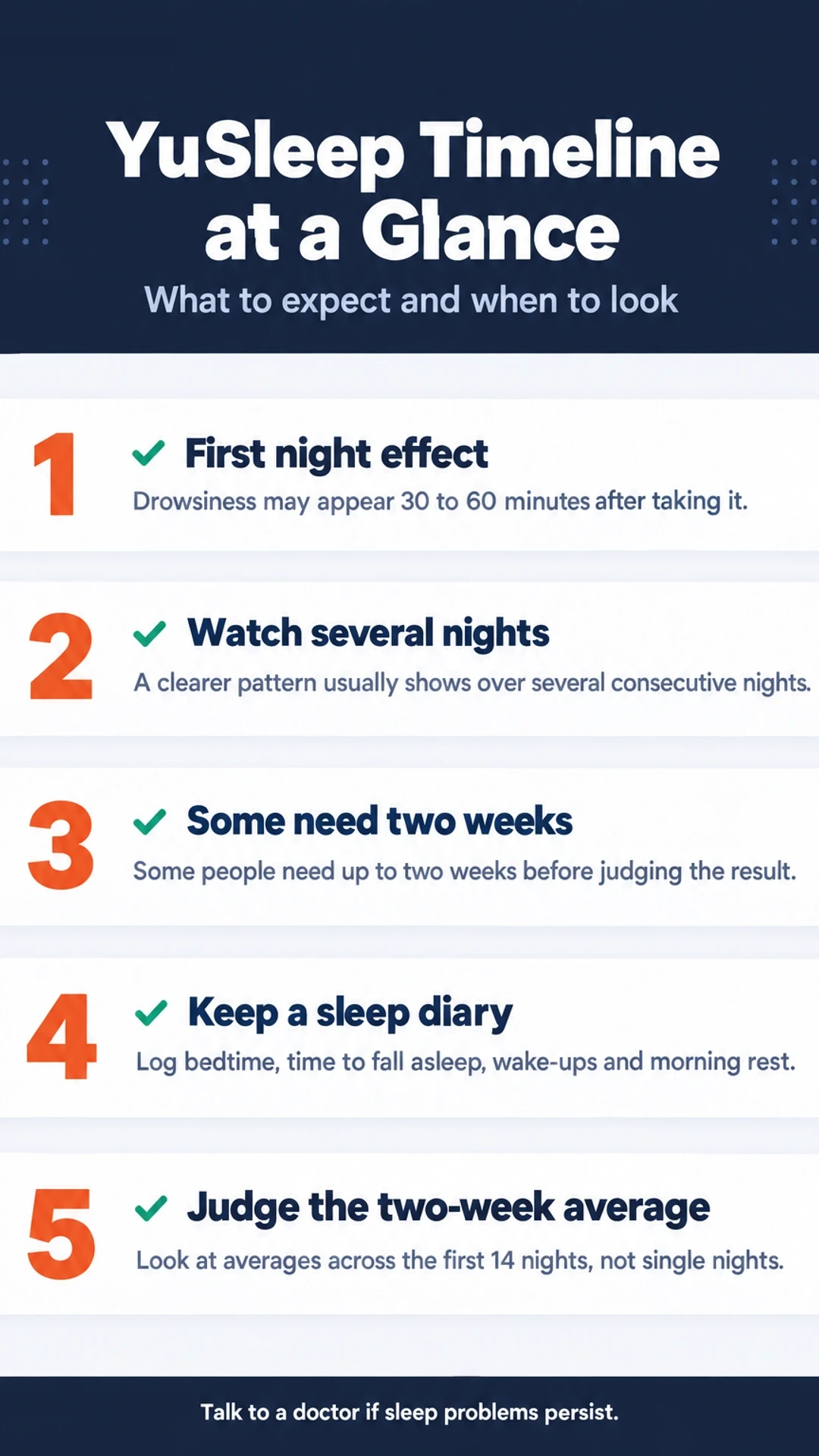
Most people using YuSleep should expect a first noticeable effect on falling asleep within about 30 to 60 minutes of taking it, and a clearer pattern over several nights. Vendor materials describe results as varying between users, and some people notice changes within a few nights while others need up to two weeks. Judge it over a consistent two-week period, not after one night.
Some links on this site are affiliate links: if you buy through one, the site may earn a commission at no extra cost to you. More about this.
Here is what this guide covers:
- Typical timing: when a first effect usually shows up, and what counts as a noticeable change
- Why people differ: the factors that tend to speed up or slow down how quickly someone responds
- A two-week tracking plan: what to write down each night so you can judge the result fairly
- When to stop waiting: the signs that suggest it is time to talk to a doctor instead
- Where to find the details: links to our dosing, ingredient, and safety pages
If you have been lying awake for an hour or more most nights, you already know how frustrating it is to buy something and have no idea whether it is working. You want a straight answer, not a promise that it will fix everything by Friday. This guide is based on published specifications and what buyers report, not our own testing, so we will separate what the vendor claims from what people commonly describe. You will get realistic timelines, a simple way to track your own results, and clear guidance on when waiting longer is no longer the sensible choice.
The Short Answer: When Should You Notice Anything?
If you are asking how long YuSleep takes to work, the short answer has two parts: when you might feel something on the night you take it, and when you might notice a pattern across several nights. They are not the same thing, and mixing them up is the most common source of confusion for first-time users.
Onset on the night you take it. For melatonin-type products, the commonly cited window is roughly 30 to 60 minutes before you feel drowsy. YuSleep's own material describes this timing as varying from person to person, so treat that range as a rough guide rather than a promise. If you are still wide awake an hour after taking it, that does not mean the product has failed. Some people simply need more time, and their body clock or bedtime routine may be doing more of the work than the supplement alone.
Benefit across nights. Most people find the picture becomes clearer over several consecutive nights rather than after one dose. The change you are watching for is usually something like falling asleep a little sooner, or waking less often, measured against your own usual pattern.
Why one night tells you little. Sleep shifts from night to night for reasons that have nothing to do with any supplement: a late coffee, a noisy street, a stressful day, an overheated bedroom. A single good night may be luck, and a single poor night may be the ordinary variation every person experiences. Keep a simple note of when you took the product, when you got into bed, and roughly when you fell asleep. A week or two of notes will tell you far more than any one evening.
Typical timing by what you notice
| What you notice | When to look | Judge it by |
|---|---|---|
| Drowsiness on the night taken | About 30 to 60 minutes after taking | Single evening, rough guide |
| Benefit across nights | Over several consecutive nights | Pattern across a week or two |
| Falling asleep sooner | First few nights | Time to fall asleep in your diary |
| Fewer night wake-ups | Often later than falling asleep | Wake count in your diary |
How Long YuSleep Takes to Work by Reason for Use
Most people don't take a supplement to fix "sleep" in general. They take it for a specific problem, and that problem shapes how quickly you should expect to notice a difference. Judging the timeline by the reason you started is more useful than asking whether it works at all.
How long until I fall asleep faster?
This is the most direct effect to look for, and it's usually the first one people notice. If your main issue is lying awake for a long time after the lights go off, pay attention to how quickly you drift off on the first few nights. A change in how long it takes you to get asleep is easier to spot than a change in how rested you feel.
How long until I stop waking in the night?
Staying asleep is a different job from getting there, and it often shows a difference more slowly. If you wake at 3 a.m. or wake far too early, you may not see much change in the first few nights, even if you're falling asleep more easily. Give this part of your routine more time before deciding it isn't working.
How long until my timing resets after jet lag or a shift change?
Here the effect depends on when you take it relative to your new schedule. Timing it consistently matters more than the number of doses. For a shift change or a time zone shift, expect to need several days of taking it at the same time, and count your progress from when you started that routine, not from the first dose.
How long until my sleep quality feels better?
This is the hardest to judge, and the easiest to overestimate after a short period. "Better quality sleep" is vague, and a few good nights can feel like a turning point when they're just normal variation. Keep a simple note of how you feel on waking over a few weeks before drawing conclusions.
Timing by reason for use
| Reason for use | What to watch | Timing note |
|---|---|---|
| Falling asleep faster | Time to drift off | Usually noticed first |
| Staying asleep | Night wake-ups | Often slower to show |
| Jet lag or shift change | Consistent daily timing | Count from start of routine |
| Sleep quality | Feeling on waking | Hardest to judge |
Why Timelines Differ From Person to Person
There is no single answer to how long YuSleep takes to work, and the reason is that several things besides the supplement itself shape how quickly you notice a change. Understanding these variables makes the range easier to interpret, so you can tell whether a slow start is normal or a sign something else is getting in the way.
Timing matters. Taking a sleep aid too close to bedtime can leave you waiting longer than you expect, while taking it hours too early can mean the effect has faded by the time you actually want to sleep. Check the label and the directions for guidance on when to take it, and keep that timing consistent for a fair trial.
Your baseline habits can mask the change. Late screen use, irregular wake times, and caffeine or alcohol in the afternoon and evening all make it harder to fall asleep. If these are present, a supplement may be doing some work that you cannot see, because the other factors are pulling the other way.
Your sleep environment counts too. Noise, bright light and a room that is too warm or too cold affect how quickly you fall asleep, whatever you take. A supplement cannot fully compensate for a bedroom that keeps your brain alert.
Expectations shape the verdict. Many people expect a fast, sedative feeling, like a sleeping pill. A product that works more gently may seem slow or ineffective by that standard, even when it is helping your body settle into sleep. Judging it against a realistic goal gives you a fairer picture.
How to Track Your Own Timeline Over Two Weeks
Most people who ask how long YuSleep takes to work are really asking whether they will notice a difference, and when. Memory is a poor tool for answering that. A bad night feels worse in hindsight, and a good night can blur into the ones around it. A short sleep diary gives you a fair picture instead of a guess.
Each morning, jot down a few details:
- The time you got into bed.
- Roughly how long it took you to fall asleep. Your best estimate is fine.
- How many times you woke during the night, and whether you stayed awake for long.
- How rested you felt on waking, on a simple scale from 1 to 5.
If you want a comparison, log the same details on nights you skip the supplement. Alternating nights is one way to do this, though it is a choice, not a requirement. Keeping a baseline makes it easier to tell whether any change belongs to the product or to something else.
Look at the average across your first 14 nights rather than any single night. One restless night means little, and one exceptional night means little too. Patterns show up in the averages. Also note anything else that changed that week, such as stress, travel, a late coffee or a shift in your routine. A sleepless night after a red-eye flight tells you something different from one after an ordinary day, and the diary lets you account for that.
When No Effect Appears: Telling a Slow Start From a Poor Fit
Most people who take a sleep product expect to feel something on the first night, and when they don't, it's natural to wonder whether the product is working at all. The honest answer is that a few nights of no obvious change doesn't tell you much on its own. What matters is the pattern over time, and whether your routine has been consistent enough for the pattern to mean anything.
A slow start is more likely when things are improving a little from night to night. You might fall asleep a few minutes sooner, wake up less often, or simply feel slightly less wired at bedtime. Those small shifts are easy to miss, so it helps to keep a short note each morning. If you can see gradual movement and your timing has been steady, giving it more time is a reasonable choice.
What if nothing changes after two weeks?
If you have taken it at a consistent time for about two weeks and you still notice no difference, that is a sensible point to stop and reassess. Extending indefinitely, hoping the effect will eventually appear, is usually not helpful. A flat pattern after a fair trial suggests the product may not suit you, or that the sleep problem has a different cause.
Reassessing might mean checking your sleep habits, your caffeine and screen use in the evening, or whether the issue is something a product can't address.
When should you speak to a professional?
Seek advice from a doctor or pharmacist if your sleep problems persist, get worse, or you are unsure whether a supplement is suitable for you. They can look at your full health picture, including any other medicines you take, and help you understand whether further steps are needed.
For dosing, timing routines, and what to do about a missed dose, see the dedicated pages in this guide.
What the Vendor Says Versus What Buyers Report
Most people reading about YuSleep want one thing: a rough sense of when they might notice anything. The honest answer is that the timing varies, and the sources available to you describe that variation in different ways.
The vendor material says that individual experiences differ. Some users notice changes within a few nights, while others need longer before they feel any difference. That is a reasonable description of how any sleep product tends to behave, since how quickly someone falls asleep depends on their routine, their stress levels and their body's own rhythms.
Buyer reports from retail and review sites tell a similar but more scattered story. Common descriptions run from quick effects to no noticeable change at all. Some people say they feel drowsy sooner, while others say the product made little difference to how long it took them to fall asleep. Both experiences fit the same pattern of variability.
Keep the limits of both sources in mind:
- Vendor material is written by the company selling the product, so it describes the best case in its own words.
- Buyer reports are anecdotes. They are useful for seeing the range of outcomes, but they are not measurements, and people who had no result are less likely to write a review.
- Neither source is an independent clinical measure. Neither tells you how the product will work for you.
Treat both as indications of what to expect, not guarantees. If you have not noticed a change after a reasonable trial, that is a useful signal in its own right.
Frequently asked questions
How long does it take for sleep deprivation to kick in?
Mild sleep loss can affect mood, focus and reaction time within a day or two of going short. Obvious effects like yawning, slower thinking and irritability usually build over several nights of too little sleep. Adults generally need about seven or more hours a night, so a few nights below that is enough to notice a difference.
How long does it take for melatonin to work for sleep?
Melatonin is usually taken about 30 minutes to two hours before bed, and many people notice drowsiness within that window. Its timing effect on the body clock can take several days of consistent use to become clear. Results vary, and the product label or a pharmacist can confirm the right timing for a given product.
How does the body sleep?
Sleep is controlled by two processes: a homeostatic drive that builds the longer you stay awake, and a circadian rhythm, the roughly 24-hour internal clock that signals when to be alert or drowsy. Sleep cycles through stages, including light sleep, deep sleep and REM sleep, about every 90 minutes or so in most adults.
How long does it take to properly fall asleep?
Most healthy adults take somewhere around 10 to 20 minutes to fall asleep, a figure often cited as typical in sleep research. Falling asleep in under five minutes can suggest real sleepiness, while taking much longer than 30 minutes regularly may point to trouble settling. Consistent bedtimes and a calm wind-down often shorten that time.
How long should a first-time user give YuSleep before judging it?
Published specifications and buyer reports are the best guide here, since this site has not tested YuSleep. Many first-time users judge a sleep product over several consecutive nights rather than one, because sleep aids often work more consistently once a routine is established. Check the label for any stated timeframe and speak with a doctor if sleep problems persist.
Wrapping up
Most people should expect any effect to be gradual rather than immediate, so judging YuSleep after a single night is rarely fair. Track how you feel over several nights, and keep bedtime and wake time consistent. If you notice little change over that period, or your sleep problems continue, check the label and talk to a doctor. What timeline did you notice when you first tried a sleep aid? Share it in the comments.