Yusleep ReviewYuSleep for Kids and Teenagers: What the Age Limits Say
YuSleep for Kids and Teenagers: What the Age Limits Say
The short answer
YuSleep is presented by its vendor as a sleep supplement for adults, and the product materials we reviewed do not give a clear minimum age for children or teenagers. Because it contains melatonin and other active ingredients, parents should not give it to a child without first speaking to a pediatrician. Checking the label for an age statement and discussing sleep problems with a doctor is the safest first step.
Some links on this site are affiliate links: if you buy through one, the site may earn a commission at no extra cost to you. More about this.
Age statement: what the label does and does not say about younger users Why melatonin matters: how active ingredients affect children differently from adults Questions for a doctor: what to bring up before any sleep product is considered Safer alternatives: non-supplement approaches to bedtime routines for kids and teens How to read the packaging: the specific wording to look for on the label
If your child is struggling to fall asleep, you are probably looking for something that works tonight, not a long list of caveats. We understand that. A sleepless child affects the whole household, and it is tempting to reach for whatever a friend or an online ad recommends. Our aim here is to give you a clearer picture than the marketing does, so you can make a decision you can defend.
This guide is based on published specifications and what buyers report, not our own testing. We looked at what the vendor states about who the product is for, what the ingredient list contains, and how those points compare with common guidance on children's sleep. Where we found no clear statement, we say so rather than fill the gap with assumptions.
Read on for what the age limits say, why ingredients deserve extra care in younger users, and which questions to take to a pediatrician. You will also find practical steps for checking any label yourself.
What the YuSleep Label and Vendor Say About Age
Because of that, we can only tell you what the published materials say, and where they stay silent.
We checked the official site and the product packaging for any statement about age. Here is what we found:
- Official site: We did not find a clear minimum age or a statement that the product is intended for children or teenagers. If you are looking at the page before you order, read the full product section yourself, since wording can change.
- Packaging and bottle label: Check the label for any age wording before you buy or give it to anyone. We are not quoting a specific age here, because we have not confirmed one from the label text.
- Gaps: Where a statement is missing, you should treat the question as unanswered, not as settled.
Does a missing age statement mean it is safe for kids?
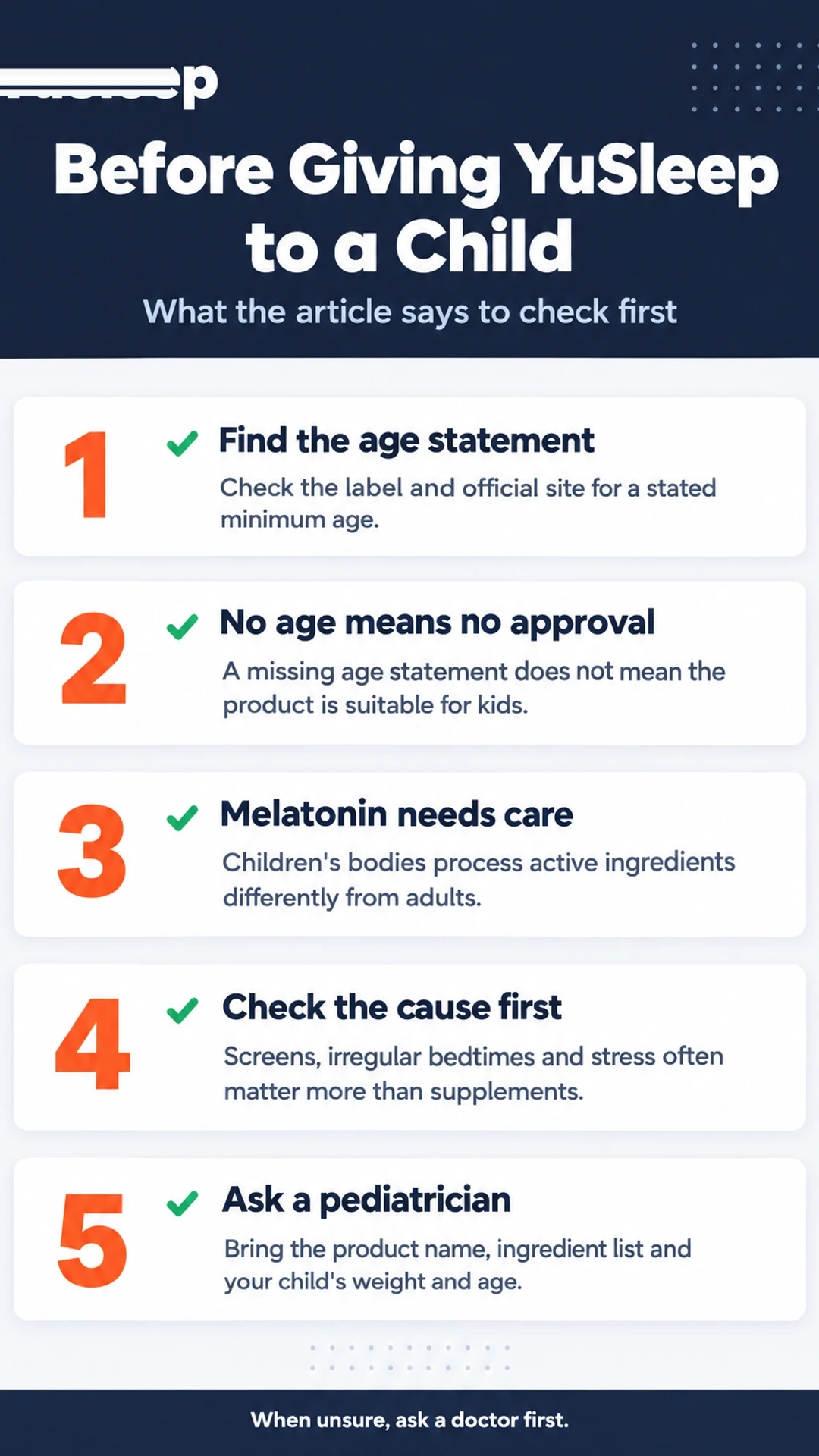
No. A missing age statement is not the same as approval for children. A product can be sold without a recommended age, and that silence tells you nothing about whether it suits a young person. If you are shopping for a child or teen, the safest step is to ask a pediatrician or other qualified health professional before giving any sleep product.
Do retailer pages match the label?
Not always. Retailer listings and summary pages sometimes paraphrase, shorten or leave out warnings that appear on the product's own label. If a third-party page mentions an age, check it against the bottle itself. The label is the document to trust, and the official site is the next place to check. Where the two disagree, ask the vendor directly before you order.
Why Children and Teenagers Are Different
A product made for adults does not shrink neatly for a child. Children's bodies absorb, process and clear substances differently from adult bodies, and that is why supplement dosing for younger people is usually calculated from body weight and age rather than simply cut in half. A label written for adults may not give any guidance for a child at all, and that gap is the first thing to check. If the YuSleep label names no minimum age or no dose for under-18s, treat that as a reason to ask a pediatrician before giving it, not as a loophole.
Sleep problems in children and teenagers also tend to have causes that a supplement does not touch. Common ones include:
- Irregular bedtimes or a routine that drifts from night to night
- Screens in the bedroom or late-evening device use
- Anxiety, worry about school, or stress at home
- Caffeine, large meals or exercise close to bedtime
If the real cause is a screen habit, a supplement will not fix it, and you may end up delaying a more useful conversation.
Teenagers add another layer. During puberty, the body's internal clock typically shifts later, so a teen who stays up late and sleeps in may not have an insomnia problem at all. Telling that apart from a true sleep disorder usually takes a closer look at timing, daytime alertness and mood, which is why a doctor is the right first stop when sleep trouble persists.
Melatonin and Young People: What Pediatric Guidance Generally Advises
Melatonin is a hormone your body makes to signal that it is time to sleep, and supplements copy that signal. Because it is a hormone-based ingredient, the dose you give matters, and so does consistency from one bottle to the next. Supplement strengths can vary from what the label says, and that gap is one reason parents and clinicians tend to be cautious about giving melatonin to children without a clear plan.
Pediatric guidance generally recommends that a clinician be involved before melatonin is used in children, especially if the goal is ongoing use. A doctor can look at why your child is not sleeping, rule out other causes, and help decide whether a supplement makes sense at all. Sleep problems in young people often have causes that respond to routine, schedule, or screen habits better than to any product.
If you are considering any sleep aid for a child or teenager, check with their doctor first. That includes products with natural-sounding ingredients, such as tart cherry extract, since "natural" does not automatically mean suitable for a young body. Bring the exact product name and the ingredient list with you, so your child's doctor can see what is actually in the bottle rather than working from memory.
Keep your questions specific:
- What age range does the product's label state, and does it match your child?
- How much is in each dose, and is the amount consistent with what your doctor expects?
- How long is the product intended to be used, and what should be done if it does not help?
For the age limits printed on the YuSleep label, check the official product page or packaging rather than relying on summaries, including this one.
Questions to Ask a Pediatrician or Pharmacist Before Giving Any Sleep Product
Before you buy anything for a child or teenager's sleep, it helps to walk into the appointment or pharmacy counter with a short list. This guide is based on published specifications, the vendor's own claims and what buyers commonly report, not on our own testing. Use the questions below to start a useful conversation.
What is causing the sleep problem, and should non-supplement steps come first?
Sleep trouble in young people often comes from screens late at night, irregular wake times, caffeine, stress, or a bedroom that is too warm or bright. Ask your clinician which of these might be involved and whether changing the routine should come before any product. Many clinicians will want to see a few weeks of consistent habits first.
Which details about the child matter?
Have these ready:
- Age and current weight
- Every medicine, supplement or herbal product they take, including occasional doses
- Any diagnoses, especially ADHD, asthma or epilepsy, since these can change how a sleep product fits
- Any allergies or sensitivities to ingredients listed on the label
What dose, how long, and what signs mean stop?
Ask directly:
- What dose is appropriate for this child's age and weight, and is the label dose the one to follow?
- How long should it be used, and when should you reassess?
- Which side effects or changes mean you should stop and call the clinician?
Check the official label or the manufacturer's site for the exact ingredients and liquid or extract strength, then read it back to the clinician so you are working from the same numbers.
How to Read a Supplement Label for Age and Dose
Before you buy any sleep product for a child or teenager, the label tells you most of what you need to know. The trick is knowing which lines matter and which are marketing.
Start with three things. Look for:
- A stated minimum age, written as a number, such as "for ages 12 and up." If no age is given, do not assume it is safe for younger users.
- A recommended dose by age or body weight. Children's doses are usually set by weight, so a single adult-sized serving is not a children's dose.
- A clear warning for children, such as "keep out of reach of children" or a statement that children should only use it under medical supervision.
Next, check the active ingredients per serving and the serving size. A melatonin figure only means something when you know how many milligrams are in one serving and how many servings the bottle counts as. Note whether the amount is listed per capsule, per gummy or per milliliter of liquid, because the same word can mean very different doses across formats.
Be cautious about vague wording. Phrases like "for adults" or "consult a doctor" are a signal to get professional advice before giving the product to a child. If the label does not say who it is for in plain terms, treat that gap as your answer and ask a pediatrician first.
Common Parent Questions About Sleep Aids for Kids
Parents often ask whether a sleep product with an age limit on its label can be used for a child, and whether it is the right first step. Treat it as a starting point for a conversation with your child's doctor.
Does a child with ADHD need a different approach to sleep?
Children with ADHD often have trouble settling at night, and their sleep may need a different plan from other kids. This is a question for the prescriber who manages your child's ADHD care. They can tell you whether medication timing, a sleep evaluation or a change in routine makes sense, and whether any sleep product fits alongside what your child already takes.
Is melatonin legal to give a child?
The answer depends on the specific product and your country. Some melatonin products are sold as supplements, others need a prescription, and age guidance on labels varies. Check the label, the ingredient list and your local rules before giving anything to a child. A pharmacist can also confirm what is appropriate.
What can you try before or alongside a supplement?
Many families find that non-supplement steps make the biggest difference:
- Keep a consistent bedtime and wake time, including on weekends.
- Dim the lights for an hour or so before bed.
- Limit screens in the evening, and keep devices out of the bedroom if you can.
- Build a short, predictable wind-down routine.
Your pediatrician can help you adapt these steps to your child's age, schedule and any other health needs.
Supplement versus routine changes for kids
| Option | Pros | Cons |
|---|---|---|
| Sleep supplement | Easy to buy and start | Needs a doctor's input first |
| Consistent bedtime routine | Addresses common causes directly | Takes several weeks to show |
| Screen limits in the evening | No product or dose to manage | Requires family agreement |
Frequently asked questions
Do ADHD kids need melatonin?
Not every child with ADHD has a sleep problem, and not every child with a sleep problem needs melatonin. Sleep trouble is common in kids with ADHD, so a pediatrician will usually first look at routine, screen use, caffeine and bedtime timing. If a supplement is considered, a doctor should make that call based on the child's age and history.
Can I legally give my child melatonin?
In the United States, melatonin is sold as a dietary supplement, so it is not regulated like a drug and can be bought without a prescription. That does not mean it is approved for every child. Rules differ by country, and the product label is not a substitute for advice from a doctor or pharmacist about your child's age and health.
What can I give my child to sleep?
For most children, the safest first steps are behavioral: a consistent bedtime, a dark and quiet room, a wind-down routine, and no screens for about an hour before bed. If sleep problems continue, speak with a pediatrician before giving any sleep aid, including supplements or over-the-counter antihistamines, which are not recommended for young children.
Is there a natural sleep aid for toddlers?
Natural does not mean risk-free or appropriate for toddlers. Herbal products and supplements are not tested for children's dosing the way medicines are, and quality can vary between brands. Before using any sleep aid with a toddler, check with a pediatrician, especially if the child has other health conditions or takes other medicines.
What age limits should I check on a sleep supplement label?
Look for a stated minimum age and read it as a real limit, not a suggestion. If the label gives no age range, or only says 'adults' or 'adults and teens', treat it as not designed for younger children. Also check the dose per serving, since dosing is usually set for adults and does not scale down by body weight without medical guidance.
Wrapping up
The age limit on a sleep product is the first thing to check, not the last. For children and teenagers, routine and bedtime habits are the usual starting point. Any supplement for a child should be discussed with a pediatrician first, especially with ADHD or other conditions. Have you checked the age range on a sleep product before giving it to your child? Share what you found in the comments.